Increased Lumbar Lordosis, Disc
Degeneration and Sciatica
An increased inward curve in the lower back, often called hyperlordosis, can sometimes be seen alongside lower-back pain, stiffness and symptoms travelling into the leg. Understanding how spinal posture, discs and nerves interact can help explain why symptoms develop — and how treatment and exercise may help.
What is Increased Lumbar Lordosis?
Lumbar lordosis is the natural inward curve of the lower back. Everyone’s spinal shape is individual and influenced by their pelvic shape, balance of muscle strength and overall posture. However, when the curve becomes more pronounced, it may be described as increased lumbar lordosis or hyperlordosis.
The spine works as a connected system, a more pronounced lower-back curve can alter how load is shared throughout the lumbar discs, facet joints and supporting muscles. The body may also compensate by changing the position of the pelvis, upper back and neck. This does not mean that increased lordosis automatically causes degeneration throughout the spine, but persistent altered loading may contribute to mechanical stress and degenerative changes over time [1][3].
How can the Lumbar Discs Be Affected?
The lumbar discs sit between the vertebrae and act as shock absorbers. Over time, discs can gradually lose hydration, height and resilience. This is a normal part of ageing for many people, but the process can be influenced by genetics, body weight, previous injury, activity levels and spinal alignment [1][3].
With increased lordosis, loading through the lower back may change. This can place greater stress on the posterior structures of the spine, including the facet joints, while also affecting the way the discs manage movement and force. The lower lumbar levels, particularly L4/L5 and L5/S1, are commonly affected because they carry substantial load and movement.
From Disc Protrusion to Sciatica
If a disc bulges, protrudes or herniates, it may compress a nearby spinal nerve root. These nerve roots contribute to the sciatic nerve, which travels from the lower back into the buttock and down the leg [5].
This may cause sciatic pain that can travel from the lower back or buttock, down the back or outer side of the thigh and calf, and into the foot. People may describe the pain as sharp, burning, electric, shooting or aching. Other symptoms can include pins and needles, numbness, altered sensation or weakness in the leg [5].
For example, irritation around the L5 nerve root may affect sensation along the outer leg and into the top of the foot. S1 nerve-root irritation may cause symptoms travelling behind the leg, through the calf, and into the outer foot or sole. Symptoms do not always follow an exact pattern, which is why a proper assessment is important [5].
A Scan Does Not Always Tell the Whole Story
It is important not to assume that every disc change seen on an MRI scan is the cause of pain. Disc bulges and degeneration can be present in people who have no symptoms at all. Imaging findings should always be considered alongside the person’s symptoms, movement, function and clinical assessment [2].
Exercise Helps
Exercise is often an important part of managing lower-back pain and sciatica symptoms. A programme can be tailored to improve hip mobility, pelvic control, core endurance and gluteal strength. The aim is not to force the spine into a “perfect” posture, but to improve movement, strength and confidence with everyday activity.
Exercises should be chosen and progressed around the person’s symptoms and capabilities. Remaining as active as possible within tolerance is generally encouraged, rather than avoiding all movement through fear of causing damage [4].
How Deep Muscle Sports Massage May Help
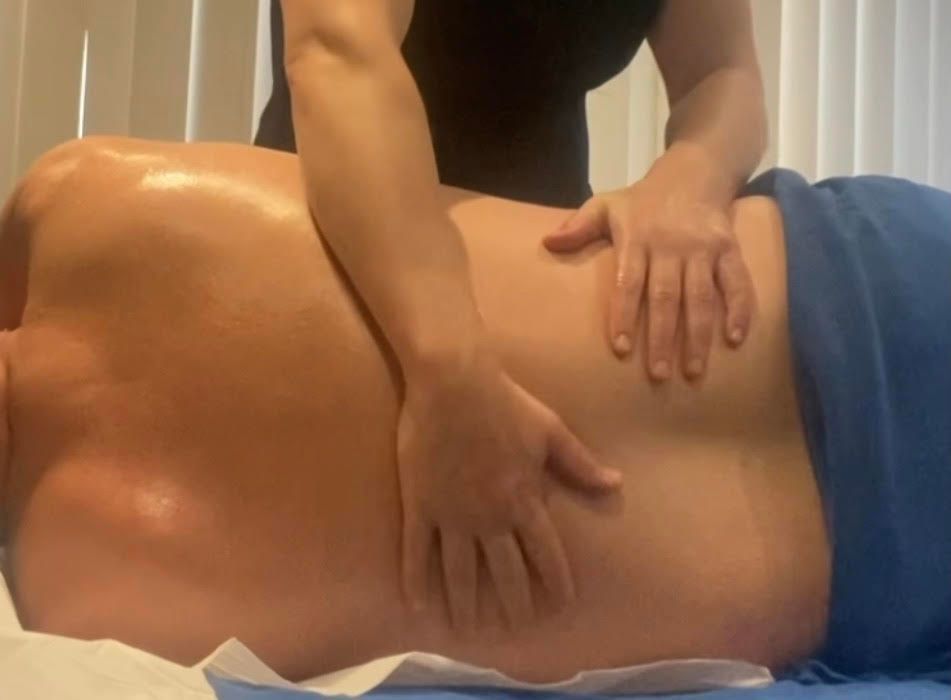
Deep muscle sports massage may help where protective muscle tension contributes to pain, reduced movement or difficulty exercising. Treatment may focus on the lumbar muscles, gluteals, hip flexors, hamstrings and piriformis region, depending on the individual assessment.
Massage can help reduce the feeling of tightness, improve comfort with movement and support a gradual return to exercise. However, it does not “put a disc back in” or reverse spinal degeneration. It is most useful as part of a wider plan that includes movement, strengthening, activity modification and appropriate clinical assessment. NICE includes soft-tissue techniques, such as massage, as a possible part of a treatment package that also includes exercise for low-back pain with or without sciatica [4].
Deep pressure should always be adapted or avoided if it aggravates nerve symptoms, particularly worsening pain down the leg, tingling, numbness or weakness.
When to Seek Urgent Medical Advice
Urgent medical assessment is needed if there is progressive leg weakness, numbness around the saddle area, or changes to bladder or bowel control.
References
[1] Berven, S. and Wadhwa, R. (2018) ‘Sagittal alignment of the lumbar spine’, Neurosurgery Clinics of North America, 29(3), pp. 331–339. doi: 10.1016/j.nec.2018.03.009.
[2] Brinjikji, W., Diehn, F.E., Jarvik, J.G., Carr, C.M., Kallmes, D.F., Murad, M.H. and Luetmer, P.H. (2015) ‘MRI findings of disc degeneration are more prevalent in adults with low back pain than in asymptomatic controls: a systematic review and meta-analysis’, American Journal of Neuroradiology, 36(12), pp. 2394–2399. doi: 10.3174/ajnr.A4498.
[3] Fasser, M.-R., Furrer, P.R., Fisler, L., Urbanschitz, L., Snedeker, J.G., Farshad, M. and Widmer, J. (2025) ‘The triadic relationship between spinal posture, loading, and degeneration’, Frontiers in Bioengineering and Biotechnology, 13, 1444540. doi: 10.3389/fbioe.2025.1444540.
[4] National Institute for Health and Care Excellence (2020) Low back pain and sciatica in over 16s: assessment and management (NG59). Available at: https://www.nice.org.uk/guidance/ng59 (Accessed: 4 October 2026).
[5] Soar, H., Comer, C., Wilby, M.J. and Baranidharan, G. (2022) ‘Lumbar radicular pain’, BJA Education, 22(9), pp. 343–349. doi: 10.1016/j.bjae.2022.05.003.